
Dawn of War 4 Units List: Every Confirmed Unit
Every confirmed Dawn of War 4 unit by faction, with combat roles: Space Marines, Orks, Necrons and Adeptus Mechanicus infantry, vehicles and specialists.
Quick answer: Dawn of War 4 has four faction rosters built around distinct jobs rather than mirrored unit types. Space Marines rely on elite infantry and armor, Orks on cheap melee waves and specialists, Necrons on durable infantry and matrix support, and AdMech on ranged firepower and network buffs. This list covers every unit confirmed in official material.
The launch roster is smaller than a live-service game's, and that is deliberate. Each faction has a clear core, a few specialist answers and a small number of high-impact vehicles or monsters. The units you build should answer a specific problem, not fill a symmetrical tech tree.
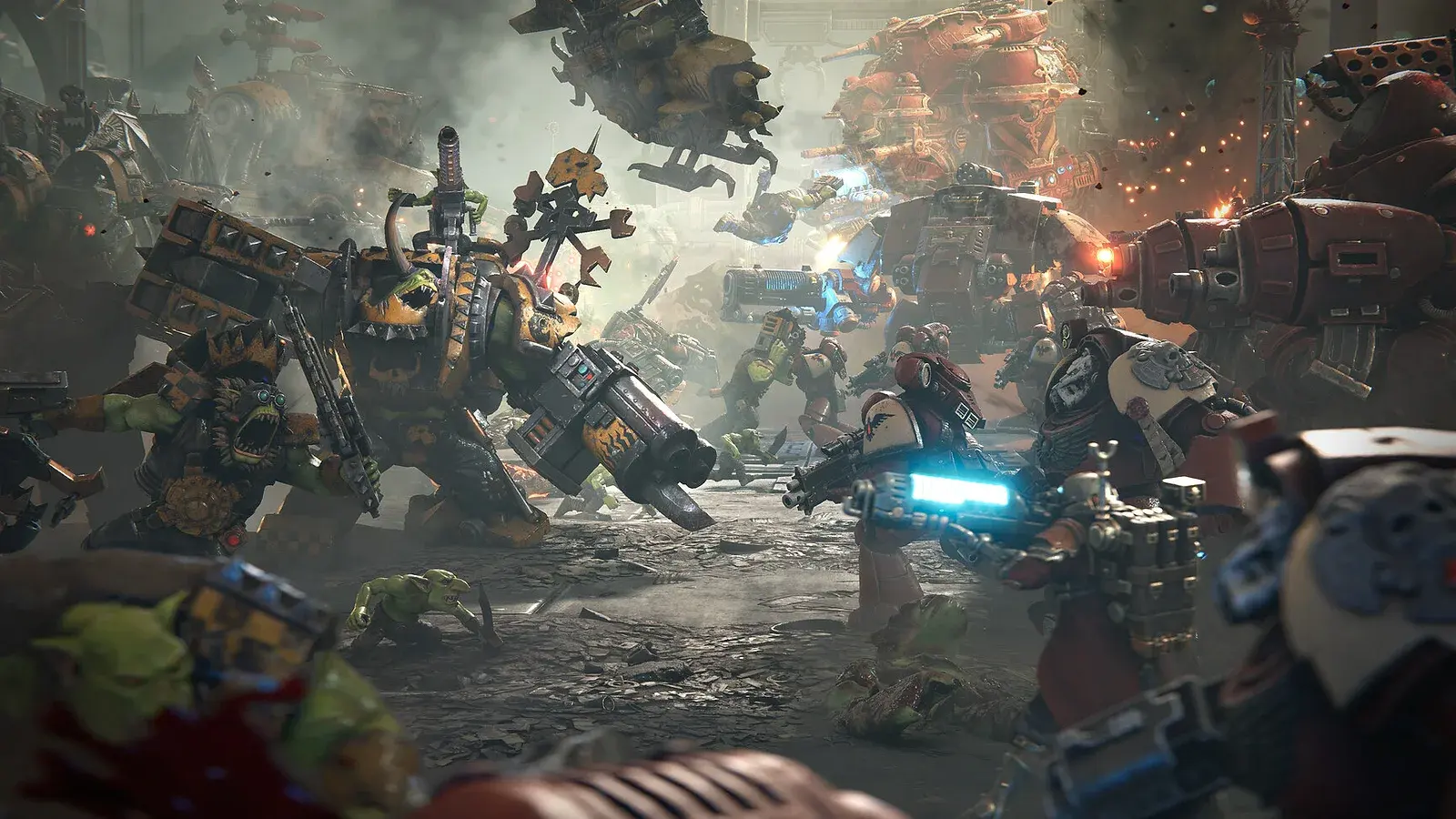
This page lists the units by faction and explains what each one is for. For the army-level comparison, start with the Dawn of War 4 factions overview→. For the answer to a specific unit, use the counters guide→.
Official source: Warhammer 40,000: Dawn of War IV on Steam ↗ — official release date, factions, modes and system requirements.
A cheap unit that does the right job beats an expensive unit that does not. The Dawn of War 4 counters page→ shows how the roles interact.
How to read this units list
The list is organized by faction and role. It is not a stats table: the launch build has no public unit stats, and inventing exact damage or health numbers would be worse than useless. What matters at the planning stage is the job each unit performs and the decision it forces on the opponent.
The categories are:
- Line: the unit that holds space and absorbs fire.
- Damage: the unit that kills things.
- Screen: the unit that keeps melee off your damage.
- Raider: the unit that punishes exposed positions.
- Anchor: the expensive unit that decides a late-game fight.
- Support: the unit that changes the army's economy or positioning.
Space Marine units
Space Marines have the smallest roster and the highest average cost. Their units are designed to trade efficiently, not to flood the map.
| Unit | Category | Job |
|---|---|---|
| Tactical infantry | Line | Holds points and absorbs fire while specialists work |
| Infiltrators | Screen / raider | Takes ground, provides vision and forces the enemy to reveal |
| Eliminators | Damage | Long-range deletion of commanders and high-value squads |
| Redemptor Dreadnought | Anchor | Breaks infantry lines and tanks return fire |
| Orbital reserves / Drop Pod | Support | Reinforces a push without a base trip |
| Thunderhawk Relay | Support | Redeploys the small Marine army between lanes |
The Marine roster is the easiest to understand and the hardest to use well. Every unit is expensive, so every unit needs to justify its cost. Infiltrators justify theirs by controlling vision; Eliminators justify theirs by removing a unit that would otherwise win a fight; the Dreadnought justifies its cost by being the unit the enemy cannot ignore.
Marine vehicles are not a separate army. A Dreadnought without infantry support is a large target, and a Razorback-style transport without a squad to deliver is a wasted investment. The faction wants combined arms, not a vehicle ball.
Ork units
Orks have the widest cheap roster. The faction's strength is not any single unit but the number of units it can put on the field.
| Unit | Category | Job |
|---|---|---|
| Slugga Boyz | Line | Cheap melee bodies and the backbone of every wave |
| Shoota Boyz | Damage | Ranged fire support that does not slow the wave |
| Flash Gitz | Damage | Heavy ranged fire against armor and clumps |
| Squighog Riders | Raider | Fast flank attacks and pursuit |
| Meganobz | Anchor | Elite infantry that converts a swarm into a late army |
| Burna Boyz | Damage / anti-swarm | Clears clustered light infantry |
| Gretchin | Support | Cheap bodies, screening and objective fodder |
The important choice inside the Ork roster is Meganobz upgrades. Kombi-Rokkits turn them into ranged anti-armor; Kombi-Skorchas turn them into short-range area damage. The right choice depends on what the enemy is building, and a mixed unit is often better than a pure one.
Burna-equipped Boyz are the other key specialist. Against a player who clumps infantry, a few Burnas can decide a fight. Against a vehicle army, those resources are better spent elsewhere. The Ork roster rewards reading the opponent's composition, not building the same 20-unit blob every game.
Necron units
Necrons have the most durable core and the most support-dependent roster. Their units are designed to fight on the Power Matrix and grind out trades.
| Unit | Category | Job |
|---|---|---|
| Necron Warriors | Line | Durable infantry that benefits most from matrix healing |
| Scarabs | Raider | Cheap, fast harassment and tying up ranged units |
| Deathmarks | Damage | Sniping commanders and high-value specialists |
| Doomstalkers | Damage | Anti-armor fire support |
| Canoptek Spyders | Support | Builds Tomb Pylons and extends the matrix |
| Monolith | Anchor | Late-game reserve engine and frontline centerpiece |
| Resurrection Galleries | Support (structure) | Free replacement of a chosen unit type |
The Necron roster is smaller in effective variety because so much of its power sits in structures and positioning. A Necron army without a matrix is a collection of slow infantry; a Necron army with a matrix, a gallery and a pylon is a fortress that can move.
Deathmarks are the unit that most changes a matchup. Against a commander-centric army, a single Deathmark squad forces the opponent to keep their key model out of sight. Against a swarm, Deathmarks are less useful, and the resources are better spent on area damage or more Warriors.
Adeptus Mechanicus units
AdMech has the most specialized roster. Its units are fast, ranged and fragile, and they depend on the network to reach their full power.
| Unit | Category | Job |
|---|---|---|
| Skitarii Rangers | Damage | Core ranged infantry and the main source of firepower |
| Ruststalkers | Screen | Melee screen that pushes enemy infantry into firing lines |
| Ironstrider Ballistarius | Raider / damage | Fast mobile fire support |
| Onager Dunecrawler | Anchor | Durable walker that holds a firing line |
| Skorpius Disintegrator | Damage | Long-range fire against static armies |
| Knight Castellan | Anchor | Late-game centerpiece dropped from orbit |
| Void Shield | Support (structure) | Protects a key position and buys time |
The AdMech roster is the least forgiving in the game because every unit is a specialist. A pure Ranger army gets run over by melee. A pure Ruststalker army has no damage. A Castellan without a screen is an expensive target. The faction wants a combined-arms formation in the most literal sense: a screen in front, damage behind, and a network underneath.
Units that are confirmed but not standard
Some units appear only in specific contexts. Campaign-only units, Last Stand companions and commander-specific summons are not part of the standard multiplayer roster. They are still worth knowing because the campaign uses them to teach mechanics that carry over.
The most important examples are the campaign variants of each faction's hero and the Last Stand companion units. Last Stand gives each commander up to four companion units, chosen from the faction's roster, and the mode's progression unlocks wargear rather than raw stat upgrades. That means a unit that is mediocre in a standard match can be excellent in Last Stand because the mode rewards combination and timing over raw efficiency.
For the mode-specific roster, see the Dawn of War 4 Last Stand guide→.
What is missing from the launch roster?
The launch roster does not include Eldar, Tau, Tyranids or Chaos. It also does not include every unit from previous Dawn of War games. The faction design is a deliberate reset: four armies, each with a clear identity, rather than a large roster with overlapping roles.
That matters for list-building because you cannot assume a missing unit will fill a gap. If a faction lacks a dedicated artillery piece, it has to solve that problem with a different tool. If a faction lacks a cheap anti-air unit, it has to rely on a generalist. The counters guide→ is organized around those gaps rather than around a symmetrical unit table.
FAQ
How many units are in Dawn of War 4?
The launch roster has not been published as a single number. The confirmed units across the four factions cover line infantry, specialists, vehicles, monsters and support structures, with each faction fielding a focused rather than mirrored roster.
Are there Titans in Dawn of War 4?
The Knight Castellan is the largest confirmed AdMech war machine. There is no confirmed Titan unit in the launch roster; the game's scale is closer to company-level RTS combat than to Titan-scale battles.
Can every faction build vehicles?
Space Marines, Orks and AdMech all field vehicles or walkers. Necrons rely more on constructs and the Monolith. The exact vehicle count per faction is smaller than in a traditional base-building RTS.
Where is the full unit stats table?
There is no official public stats table for the launch build. This page lists roles and jobs rather than invented numbers. Stats guides will become useful only after the game is live and the community can test them.
Sources
- Warhammer 40,000: Dawn of War IV on Steam ↗ — official feature and faction list.
- Dawn of War IV official site ↗ — faction unit previews.
- Dawn of War IV Steam news hub ↗ — developer unit deep dives.