
Dawn of War 4 Last Stand Guide: 20 Waves, 3 Players
Dawn of War 4 Last Stand explained: three-player co-op, 20 waves, commander plus four companion units, scoring, supplies, wargear unlocks and team composition.
Quick answer: Last Stand is Dawn of War 4's three-player co-op survival mode. Each player controls one commander plus up to four companion units, fights 20 escalating waves, and earns score for clear speed, commander survival and strategic point control. Experience unlocks wargear and unit options rather than raw stat upgrades.
Last Stand is the mode for players who want the faction fantasy without the ladder anxiety. It keeps the core combat systems, removes base building and turns the match into a sequence of defensive decisions. The mode is cooperative, but it is not easy: the waves escalate, the deployment budget is limited and a team that does not plan its composition will collapse around the same wave every run.
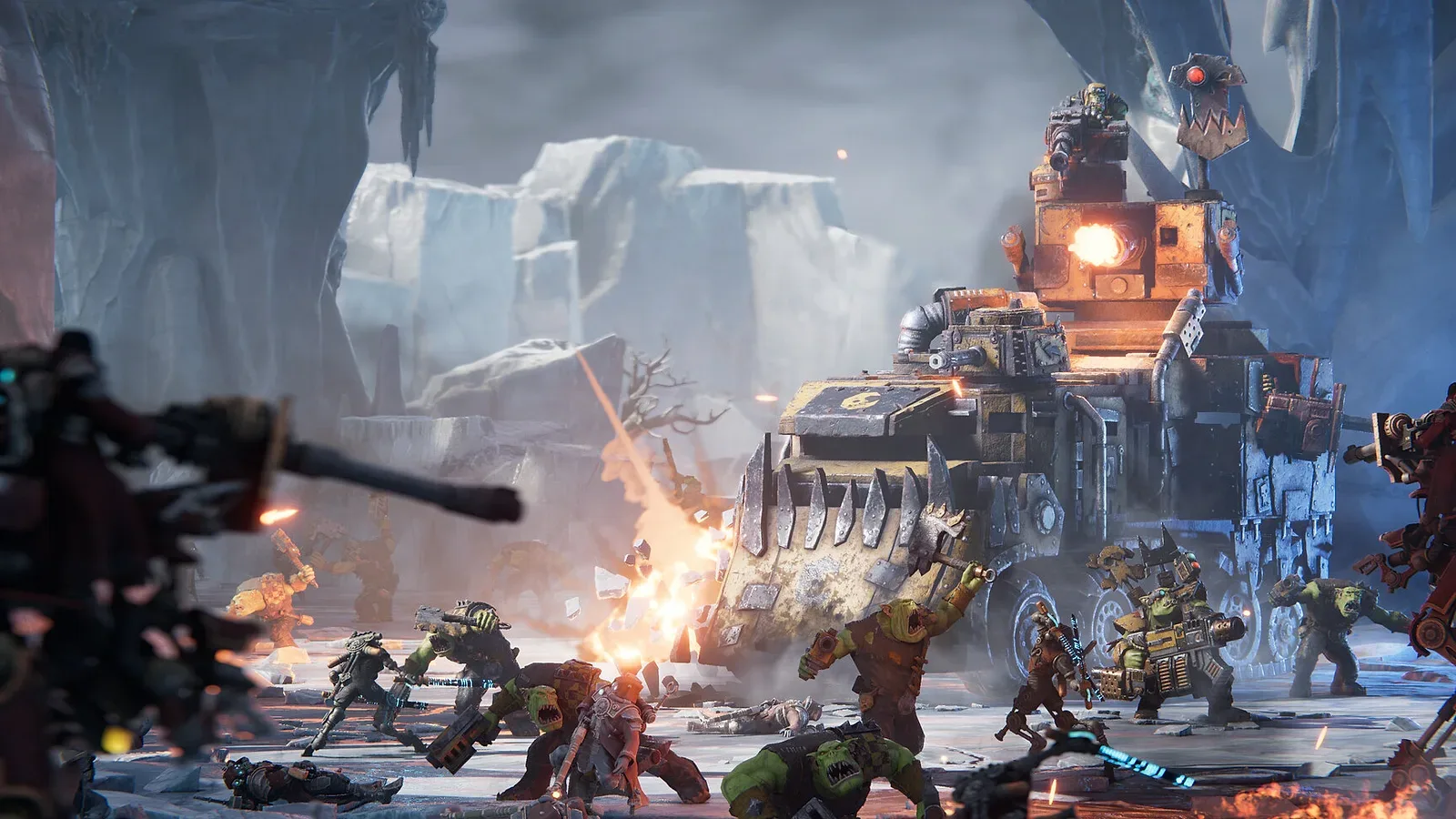
This guide covers the mode structure, the scoring system, the best team compositions and the progression loop. For the competitive alternative, see the Dawn of War 4 multiplayer guide→.
Official source: Warhammer 40,000: Dawn of War IV on Steam ↗ — official release date, factions, modes and system requirements.
A commander that is strong in 1v1 may be the wrong pick for 20 waves. The Dawn of War 4 heroes and commanders guide→ lists every role.
How Last Stand works
Last Stand is a wave defense mode for three players. Each player picks a commander and builds a small force from that faction's roster. The team holds a position against 20 waves of enemies, with limited deployment points and no traditional economy.
The structure is:
- Three players. The mode is designed for three, not one or two. A missing player changes the difficulty dramatically.
- One commander per player. The commander is the core of the build, not a disposable unit.
- Up to four companion units. Each commander can bring four companion units, chosen from the faction's roster.
- Twenty waves. The waves escalate in composition and pressure. The final waves are the real test.
- Limited deployment points. You cannot build an unlimited army. Every companion choice is a trade.
The mode is not a campaign mission with three players. It has its own progression, its own scoring and its own balance. A unit that is mediocre in a standard match can be excellent in Last Stand because the mode rewards combination and timing over raw efficiency.

The scoring system
Last Stand scores three things:
- Clear speed. Faster waves earn more score.
- Commander survival. Keeping your commander alive is worth more than a risky push.
- Strategic point control. Holding the marked points earns score and provides supplies.
The scoring system tells you how the mode is meant to be played. It is not a pure kill race. A team that clears slowly but keeps all three commanders alive and holds the points will outperform a team that clears fast and loses a commander. The points also give supplies, which can be used to heal and sustain the team.
The practical implication is that you should not sacrifice a commander for a fast wave clear. The score penalty and the loss of a player's army usually outweigh the time saved. Play for survival first, speed second.
Team composition
The strongest Last Stand teams cover three jobs: a frontline that can absorb waves, a damage core that can kill elites and a support element that keeps the other two alive.
- Frontline: Space Marines with a durable commander and a Dreadnought-style anchor, or Orks with a Meganob core. The frontline's job is to hold the chokepoint and stop the wave from reaching the damage.
- Damage: AdMech with Rangers and a Castellan-style anchor, or Space Marines with Eliminators. The damage core's job is to delete the wave's high-value units before they reach the line.
- Support: Necrons with Resurrection-style sustain, or any commander with healing or defensive tools. The support's job is to keep the frontline alive and cover the gaps.
The exact composition depends on the wave and the team's comfort. A team of three damage commanders will clear early waves quickly and collapse when the waves start bringing armored units. A team of three tanks will survive but clear too slowly to earn a good score. The mode rewards a balanced team more than a stacked one.
Orks are the best beginner faction for Last Stand because their commander is durable and their companion units are cheap. Space Marines are the best for players who want a clear frontline. AdMech is the best for players who want to play a damage role. Necrons are the best for players who want to support and sustain.
For the commander list, see the Dawn of War 4 heroes and commanders guide→.
Progression and wargear
Last Stand has its own progression. Each run earns experience, and experience unlocks wargear and unit options. The design is explicit that progression adds more combination options rather than raw stat upgrades. That means a high-level commander is not simply stronger; they have more ways to solve a wave.
The practical implications are:
- Play the commander you want to learn. Progression is per commander, so spreading runs across all nine commanders slows your progress on each one.
- Unlock options before chasing score. A new wargear option can change how a commander handles a wave more than a small score increase.
- Do not treat low-level runs as wasted. They are how you learn the wave patterns and the companion units.
- Replay the early waves with different compositions. The mode is short enough that experimentation is cheap.
The wargear system is also why Last Stand is a good place to learn the factions. You get to try units and abilities without the pressure of a competitive match, and the mode's structure makes the effect of each choice visible.
Wave strategy
The waves follow a pattern: light infantry, specialists, armor and mixed compositions. The exact wave list is part of the mode's discovery, but the strategic shape is consistent.
- Early waves are about economy. Clear them quickly without spending deployment points you will need later.
- Mid waves introduce armor. This is where a team without an anti-armor answer starts to struggle. Build the answer before the wave arrives.
- Late waves are about positioning. The enemy brings enough units to overwhelm a single chokepoint. Spread your commanders, cover the flanks and use the strategic points.
- The final waves are about survival. Do not chase kills. Hold the line, use your cooldowns and keep the commanders alive.
The most common Last Stand mistake is over-investing in early-wave damage and then having no answer to armor. The second most common mistake is stacking all three commanders in one spot, which makes area damage devastating and leaves the strategic points uncontested.
Last Stand vs competitive multiplayer
Last Stand and competitive multiplayer share the combat systems but reward different skills.
- Last Stand rewards planning. You choose a composition before the waves and execute it. Competitive play rewards adaptation.
- Last Stand rewards survival. A dead commander is a lost run. Competitive play rewards calculated risks.
- Last Stand rewards team composition. Three players must cover three jobs. Competitive 2v2 rewards synergy but also individual map control.
- Last Stand has no base building. Competitive play is an economy game as much as a combat game.
If you are new to Dawn of War 4, Last Stand is a good second step after the campaign. It teaches unit control and commander abilities without the pressure of a competitive opponent. If you are a competitive player, Last Stand is a low-stakes way to learn a new faction's units.
FAQ
How many players are in Dawn of War 4 Last Stand?
Three. Each player controls one commander and up to four companion units.
How many waves are in Last Stand?
Twenty waves. The waves escalate in composition and pressure, with armored and mixed waves in the later stages.
Does Last Stand have progression?
Yes. Each run earns experience that unlocks wargear and unit options. The progression adds combination options rather than raw stat upgrades.
What is the best Last Stand commander?
There is no single best commander. The mode rewards a balanced team: a frontline, a damage core and a support element. Pick the role your team is missing rather than the commander with the highest damage.
Sources
- Warhammer 40,000: Dawn of War IV on Steam ↗ — official mode list.
- Dawn of War IV official site ↗ — feature overview.
- Dawn of War IV Steam news hub ↗ — Last Stand announcement and details.