
Dawn of War 4 Campaign Guide: Missions, Co-op and Order
How the Dawn of War 4 campaign works: four interwoven faction campaigns, 70+ missions, branching choices, co-op support, mission order and story context.
Quick answer: The Dawn of War 4 campaign is four faction campaigns woven into one story. You play Space Marines, Orks, Necrons and Adeptus Mechanicus across 70+ missions, with branching choices and full solo or co-op support. The story is set about 200 years after Dark Crusade, after the Great Rift isolates Kronus.
The campaign is the biggest single piece of Dawn of War 4. It is not a tutorial attached to a multiplayer game; it is a full RTS campaign with named characters, persistent units and a story written by John French. The four campaigns intersect, so the order you play them changes what you understand about the others.
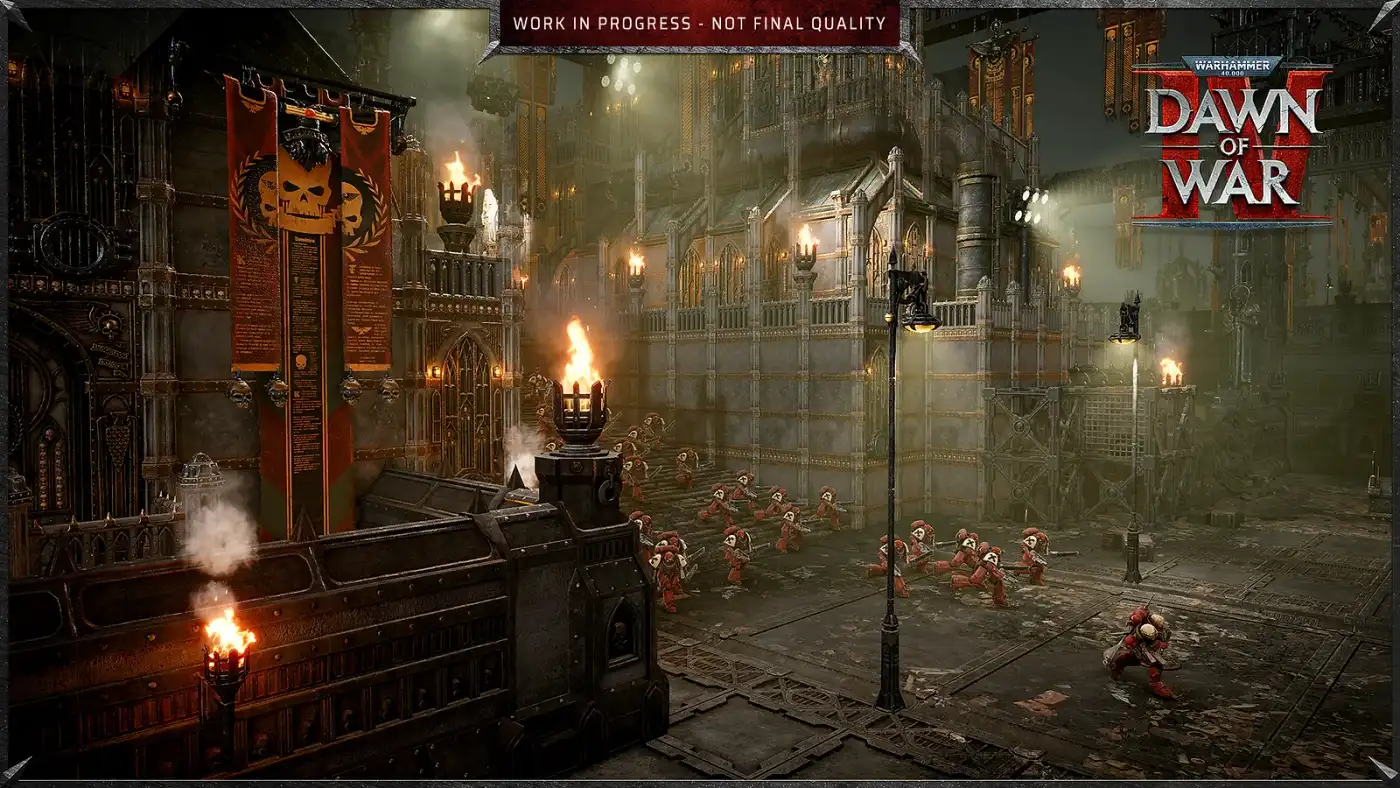
This guide explains the structure, the mission count, co-op support and the best order to play. For the armies themselves, see the Dawn of War 4 factions overview→. For the beginner systems that carry into the campaign, read the beginner guide→.
Official source: Warhammer 40,000: Dawn of War IV on Steam ↗ — official release date, factions, modes and system requirements.
Each faction sees Kronus differently. The Dawn of War 4 factions guide→ explains the four armies before you commit to a campaign order.
How many missions are in the Dawn of War 4 campaign?
The official material describes 70+ missions across four faction campaigns. That number includes the main story missions and the side missions that branch from them. It is not a single 70-mission Space Marine campaign; it is a shared campaign structure where each faction has its own thread.
The mission count is large for a modern RTS, and the branching structure means you will not see every mission in one playthrough. Some choices send you to one mission and lock another, which is why the campaign has replay value beyond the four faction perspectives.
The exact mission count per faction has not been published. Treat "70+" as the total across the campaign, not as a promise of 70 missions for your favorite army.
The story: Kronus after the Great Rift
Dawn of War 4 is set roughly 200 years after Dark Crusade. The Great Rift has torn the galaxy apart, and Kronus is isolated from the wider Imperium. The Blood Ravens are rebuilding after their losses, the Adeptus Mechanicus has arrived to investigate something beneath the surface, the Necrons are waking, and the Orks are doing what Orks do.
The four campaigns tell that story from four perspectives:
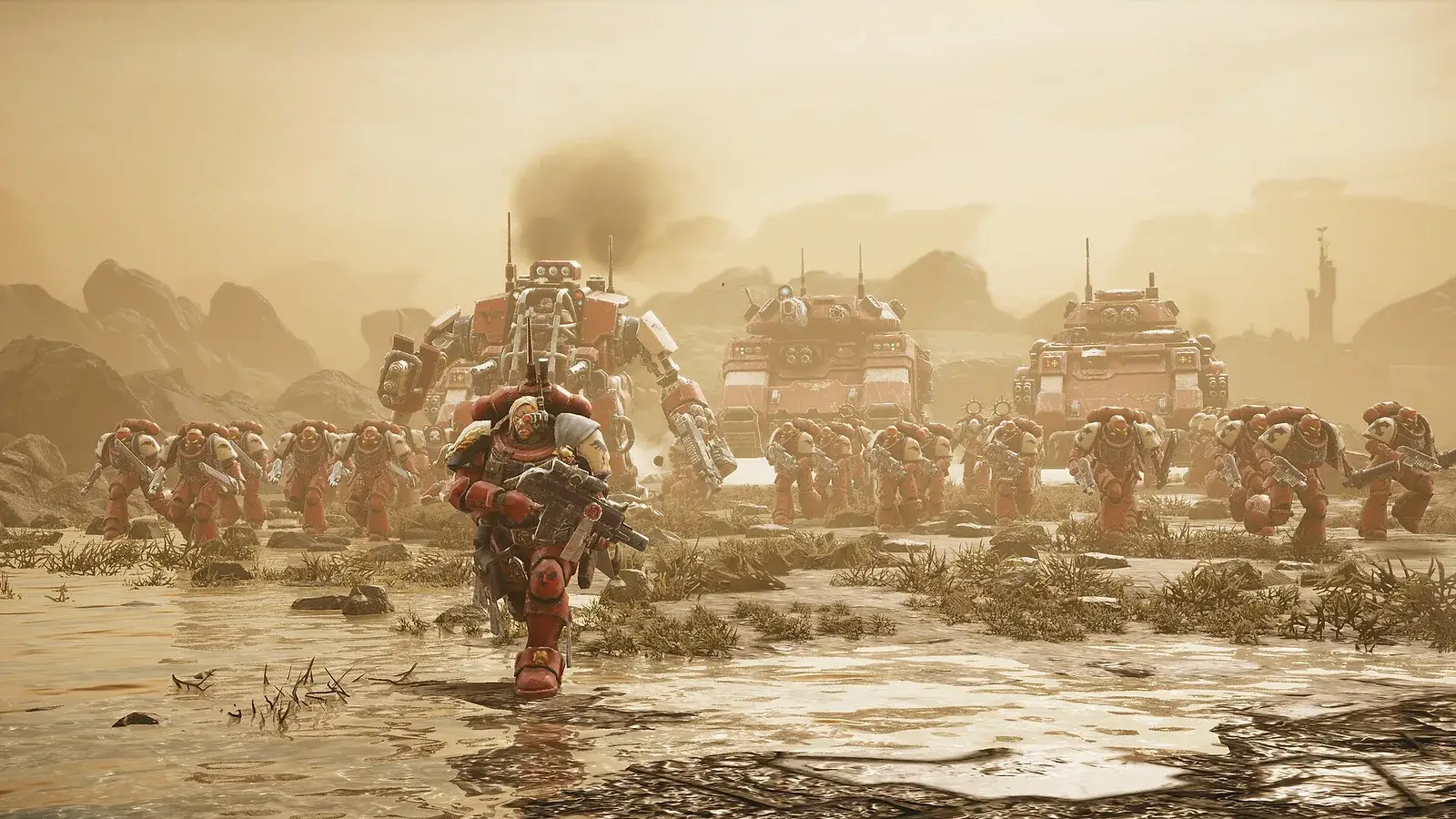
- Space Marines follow the Blood Ravens, led by Captain Cyrus and Chief Librarian Jonah Orion, with Dark Angels support from Chaplain Ezrael and Company Master Astoran.
- Orks follow Warboss Gorgutz and Beast Snagga Boss Guzcutta as they fight for a piece of the new order.
- Necrons follow the awakening of the tomb complex and the dynasty's response to the invaders above.
- Adeptus Mechanicus follow Magos Dominus Nulpherus-1 and the expedition that uncovers the Necron complex.
The campaigns are not isolated side stories. They overlap, and the choices in one thread affect what the others face. That is why the campaign is best played as a whole rather than as four separate games.
Solo and co-op
The campaign supports solo play and co-op. Co-op is not a separate mode with different missions; it is the same campaign with a second player. That makes it one of the most accessible co-op RTS campaigns in recent years, because the host's progression carries the story while both players control units.
The practical co-op advice is the same as the single-player advice, with one addition: divide the army by role rather than by unit count. One player handles the frontline and the other handles fire support, or one player controls the commander while the other manages production and reinforcements. Trying to both control everything is how co-op campaigns stall.
The game does not require co-op for any mission. Every mission is designed to be completable solo, and the difficulty scales with the number of players rather than locking content behind a partner.
Campaign order: which faction first?
There is no official order, but the structure suggests a natural sequence.
- Space Marines first. The Blood Ravens campaign is the most familiar RTS frame: durable units, clear objectives and a straightforward upgrade path. It also introduces the main conflict and the characters who appear in the other campaigns.
- Orks second. The Ork campaign is the tonal opposite: fast, aggressive and messy. Playing it after the Marines gives you a different view of the same events and teaches the pressure style that carries into multiplayer.
- Necrons third. The Necron campaign explains the threat beneath Kronus. It is slower and more defensive, which makes it a good change of pace after the Ork campaign.
- Adeptus Mechanicus last. The AdMech campaign ties the expedition, the Necron complex and the Imperial response together. It is the most satisfying as a finale because it assumes you understand the other three perspectives.
This order is a recommendation, not a requirement. If you prefer a faction, play it first; the campaign is designed to be understandable from any entry point. The only cost is that some later reveals will land differently.
Mission structure and branching
The campaign is built around a strategic layer and a tactical layer. The strategic layer shows the sector, the faction fronts and the choices that open or close missions. The tactical layer is the RTS mission itself.
Branching works on two levels. Within a mission, choices can change the objective or the enemy composition. Between missions, choices can change which thread you follow and which characters survive. The game does not advertise a single canonical path, and the official material emphasizes that the four campaigns are interwoven rather than parallel.
That has two consequences for how you play:
- Do not save-scum every choice. The campaign is designed to be played forward. Reloading to see every branch removes the weight of the decision and makes the story feel like a checklist.
- Expect to miss missions. A 70+ mission campaign with branching is not meant to be exhausted in one run. The missed missions are the reason to replay with a different faction or a different choice.
Campaign difficulty and persistence
The campaign uses persistent units and veterancy. Units that survive missions become stronger, which makes the campaign a long-form version of the multiplayer trade logic: every loss is a setback that compounds, and every veteran is an investment.
The difficulty settings change how forgiving that logic is. On lower difficulties, you can absorb losses and rebuild; on higher difficulties, a wiped squad is a real setback. The campaign does not change its rules between difficulties, only the margin for error.
The practical advice is to play the first campaign on the difficulty you would play a normal RTS campaign on. Dawn of War 4's combat is more positional than a traditional base-builder, so the learning curve is in cover and retreat, not in build orders or unit stats.
Campaign vs multiplayer: what carries over?
The core systems carry over: cover, retreat, reinforcement, veterancy and commander abilities. The economy does not. Campaign missions often give you a fixed force, scripted reinforcements or special objectives, while multiplayer starts from a standard base and a standard income.
That means the campaign is excellent practice for unit control and commander timing, but it is not a substitute for multiplayer map knowledge. A player who only plays the campaign will know how to fight; a player who only plays multiplayer will know where to fight. The best preparation is to play the campaign for the systems and then play a few multiplayer matches to learn the maps.
The reverse is also true. Multiplayer players who skip the campaign miss the story context and the commander characterization that makes the factions feel distinct. The campaign is not required homework, but it is the best way to understand why each army fights the way it does.
Campaign length and replay value
The campaign is long. 70+ missions across four factions, with branching and co-op, is a substantial time investment. The exact playtime depends on difficulty, how much of the side content you pursue and whether you play co-op.
The replay value comes from three sources: the branching choices, the four faction perspectives and the commander variety. A second playthrough with a different faction is not the same campaign with a different skin; it is a different view of the same events, with different units and different mission objectives.
If you are short on time, play the Space Marine campaign first and the AdMech campaign last. If you want the full story, play all four in the order above. If you only care about multiplayer, play the first few missions of each faction to learn the units, then move on.
FAQ
How many missions are in Dawn of War 4?
The official material describes 70+ missions across the four faction campaigns. The exact count per faction has not been published, and branching means a single playthrough will not see every mission.
Does Dawn of War 4 have co-op campaign?
Yes. The campaign supports solo and co-op play across all four faction threads.
How long is the Dawn of War 4 campaign?
The campaign is a full-length RTS campaign with 70+ missions across four factions. Playtime depends on difficulty, branching and whether you play co-op; there is no official hour count.
Do I need to play the previous Dawn of War games?
No. Dawn of War 4 is set after Dark Crusade and references earlier events, but the campaign is written as a new entry point. The story explains what you need to know.
Sources
- Warhammer 40,000: Dawn of War IV on Steam ↗ — official campaign and feature list.
- Dawn of War IV official site ↗ — story and faction overview.
- Dawn of War IV Steam news hub ↗ — campaign and story announcements.